
Flight training
Almost every civilian primary trainer seats the student and instructor side by side. Almost every military primary trainer seats them in line, one behind the other.
Both configurations have been in continuous use for more than seventy years, which means neither one is a mistake. They are answers to different questions about how a pilot should learn.
This is what each layout does, what it costs, and why the military answer has stayed consistent while the civilian answer went the other way.
What tandem seating changes
The sight picture is the same on every flight. In a tandem cockpit the student sits on the aircraft centerline. The runway on final, the horizon in a steep turn, and the picture over the nose in the flare all look identical whether an instructor is aboard or not. In a side-by-side cockpit the student sits several feet off centerline and every visual reference is offset. The day that student flies solo, nothing moves, but the picture shifts, and part of the first solo is spent recalibrating.
The student flies the aircraft alone from the first hour. In a tandem cockpit the instructor is behind the student, out of view. The student cannot read the instructor’s face for confirmation, cannot watch their hands on the controls, and cannot check whether the instructor looks concerned about the approach. Every input has to be made on the student’s own judgment. Instructors describe this as building independent aircraft control earlier, because the crutch was never available.
Communication becomes deliberate. Everything the instructor says goes over the intercom in words. Pointing at a gauge, tapping the throttle, or gesturing toward traffic is not available. Both people have to say what they mean, which is the same discipline a crew uses in a two-pilot flight deck.
What tandem seating costs
An honest account has to include the tradeoffs, because they are real.
- Demonstration is harder. An instructor who wants to show a student exactly where their hand should sit on the throttle quadrant cannot simply reach over and place it. Some instruction that happens by gesture in a side-by-side cockpit has to happen by words or in the debrief.
- Traffic calls take longer. Pointing out a converging aircraft at two o’clock is faster with a finger than with a clock position and a description.
- Early ground instruction is less efficient. Walking a brand new student through the panel before the first flight is easier when both people are looking at the same panel from the same angle.
- Instructors need time to adapt. A CFI who has taught exclusively side by side will find the first weeks in a tandem cockpit require rebuilding a teaching method around voice.
Why military training programs chose tandem anyway
Military primary and advanced trainers are overwhelmingly tandem. The T-6 Texan II, the T-38, and the T-7A Red Hawk all seat the instructor behind the student. The T-45, the Hawk, the PC-21, and the M-346 do the same.
Instructor seated behind the student
- T-6 Texan II
- T-38
- T-7A Red Hawk
- T-45
- Hawk
- PC-21
- M-346
The reason is the destination. A military student is being trained for a cockpit where they will be alone or working with a crew member who is not sitting next to them, in an aircraft where the sight picture matters at every phase of flight and where energy management is taught from the first sortie. Tandem seating puts the student in the seat they are training toward, on day one.
Tandem seating puts the student in the seat they are training toward, on day one.
The civilian side went the other way for a different reason. Side-by-side seating came with the personal aircraft that civilian training adopted, where the second seat exists so an owner can carry a passenger. Training inherited the layout along with the aircraft rather than selecting it.
What this means for a student choosing where to train
The aircraft a student trains in shapes the habits they carry into the 1,500 hours that follow, and habits built early are the ones that hold up under pressure later.
A tandem cockpit front-loads difficulty. The first ten hours are less comfortable, because the student has nowhere to look for reassurance and has to make the call themselves. The trade is that the transition to solo is smaller, the sight picture never changes, and the habit of flying the aircraft on the student’s own judgment gets built into the foundation rather than added later.
For a student aiming at an airline cockpit, the communication discipline is worth naming separately. Crew resource management is taught formally much later in a professional pilot’s training. A tandem cockpit teaches its underlying behavior, which is saying out loud what you see and what you intend, from the first lesson.
Where the MA-1 sits
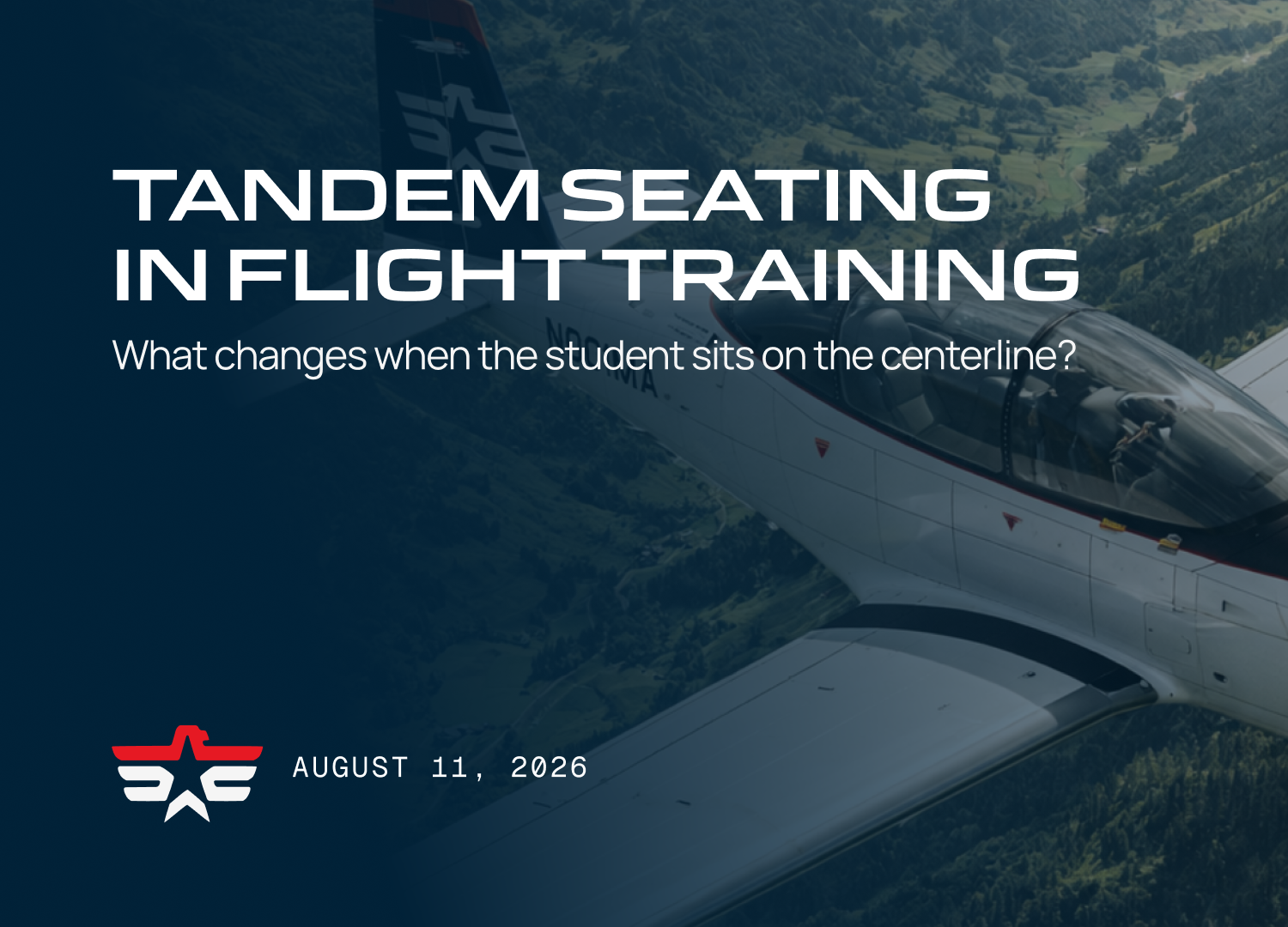
The MA-1 Blue Jay places the student and instructor in line under a high field of view canopy, with identical Garmin avionics in both cockpits. The instructor in the rear seat has the same panel, the same instrument capability, and the same engine data as the student in front, so procedures get flown rather than described.
The design includes an in-seat parachute system, with lightweight ejection seats available for programs that require an additional margin.
The MA-1 is in development toward FAA Part 23 certification. Specifications and configuration details are preliminary and subject to change.
Tandem seating is not the right answer for every mission. For a student who intends to fly professionally, and for a program built to produce those students, it puts the pilot in the correct seat from the first hour.
Follow the MA-1 program and hear when the aircraft reaches a school near you.
Follow the MA-1 program